Rabu, 30 November 2016

SUPER FOOD

SUPER FOOD


Google ‘diet’ and you’ll get nearly half-a-billion results in less time than it takes to swallow. There are diets that tell you to count calories and diets that tell you to focus on food groups. There are diets that tell you to avoid carbs and diets that tell you to carbo-load. There are diets that tell you to eat a handful of blueberries, or a handful of walnuts, or that you should load all your foods with lemon juice, cinnamon or turmeric. Eggs, potatoes and full-fat dairy are out, then they’re back in.

“The super foods fad is yet another sign of the never-ending search for a magic bullet to solve problems,” she says. “Such thinking, which ignores the multi-factorial nature of diet-related health problems, is probably the greatest myth.”

“Then it achieves a health halo and it sells, and you see this with heavily sweetened breakfast cereals,” Stanton says. “I get concerned when people find that something’s good then they stick it in their Coco Pops.” Stanton points out that she is yet to find an Australian deficient in the sort of nutrients that go into fortified cereals.

Despite Stanton's objection to painting those so-called 'superfoods' as a nutritional panacea, she supports efforts to find new, environmentally sustainable sources of food as part of a balanced diet. Marine ecologist Pia Winberg from Venus Shell Systems offered one option at the BBC Future World-Changing Ideas Summit, when she presented a convincing argument that seaweed could become a major component of food in the future.

Full Article From BBC

Will farming be fully automated in the future

Will farming be fully automated in the future


The World Bank says we'll need to produce 50% more food by 2050 if the global population continues to rise at its current pace.

But the effects of climate change could see crop yields falling by more than a quarter.

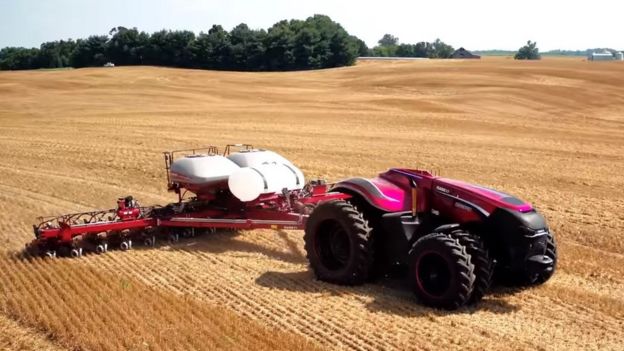
So autonomous tractors, ground-based sensors, flying drones and enclosed hydroponic farms could all help farmers produce more food, more sustainably at lower cost.

Investment bank Goldman Sachs is far more bullish, predicting a $240bn market over the next five years. Manufacturers including John Deere, CNH Industrial and AGCO are all fighting to corner the market in driverless tractors.

The Hands Free Hectare project will use flying drones and automated tractors in the coming year to grow and harvest a cereal crop.

The latest generation of this trundling four-wheeled robot can make a cut every five seconds. It has six cameras - some with infrared sensors - and two arms, and is controlled by a tablet computer inside.

The machine learns as it goes and can trim the grass around each vine. An onboard solar-powered battery gives 10-12 hours of charge, so with a change of battery, it can work day and night.

Back outside, drones are monitoring crop growth rates, spotting disease, and even spraying crops with pesticides and herbicides

From 1950 to 2010, according to the International Labour Organization (ILO), agricultural labourers as a percentage of the workforce declined from 81% to 48.2% in developing countries, and from 35% to 4.2% in developed ones.

What If We Live In Matrix Movie World

What If We Live In Matrix Movie World


Several physicists, cosmologists and technologists are now happy to entertain the idea that we are all living inside a gigantic computer simulation, experiencing a Matrix-style virtual world that we mistakenly think is real.

In June 2016, technology entrepreneur Elon Musk asserted that the odds are "a billion to one" against us living in "base reality".

Similarly, Google's machine-intelligence guru Ray Kurzweil has suggested that "maybe our whole universe is a science experiment of some junior high-school student in another universe".

Cosmologist Alan Guth of the Massachusetts Institute of Technology, US has suggested that our entire Universe might be real yet still a kind of lab experiment. The idea is that our Universe was created by some super-intelligence, much as biologists breed colonies of micro-organisms.

Philosopher Nick Bostrom of the University of Oxford in the UK has broken down this scenario into three possibilities. As he puts it, either:
  1. Intelligent civilisations never get to the stage where they can make such simulations, perhaps because they wipe themselves out first; or
  2. They get to that point, but then choose for some reason not to conduct such simulations; or
  3. We are overwhelmingly likely to be in such a simulation.
One possible answer invokes the "multiverse". Maybe there is a plethora of universes, all created in Big Bang-type events and all with different laws of physics. By chance, some of them would be fine-tuned for life – and if we were not in such a hospitable universe, we would not ask the fine-tuning question because we would not exist.

However, parallel universes are a pretty speculative idea. So it is at least conceivable that our Universe is instead a simulation whose parameters have been fine-tuned to give interesting results, like stars, galaxies and people.

While this is possible, the reasoning does not get us anywhere. After all, presumably the "real" Universe of our creators must also be fine-tuned for them to exist. In that case, positing that we are in a simulation does not explain the fine-tuning mystery.

In the early 1700s, the philosopher George Berkeley argued that the world is merely an illusion. Dismissing the idea, the ebullient English writer Samuel Johnson exclaimed "I refute it thus" – and kicked a stone.

Full Article From BBC

Sceientist Warn Us About Danger From Space

Sceientist Warn Us About  Danger From Space

Tokuhiro Nimura is a researcher at the Japan Spaceguard Association, which was formed to monitor near-Earth objects that might strike the planet. In March 2016, Nimura and his coworkers suggested that the extinctions, global cooling and iridium layer might have been caused by the Solar System passing through a molecular cloud: one of the great clouds of gas and dust in space from which stars form. As dust accumulated in the atmosphere, it would have formed a haze that reflected sunlight and cooled the planet.

The basic idea goes back to a 1975 suggestion by British astronomer William McCrea. He thought that if Earth passed through an interstellar "dust lane" it could cause an ice age. At the time, astronomers Mitchell Begelman and Martin Rees pointed out that such dust might instead affect the way particles streaming from the Sun impinge on the Earth’s atmosphere and expose the planet to high doses of radiation, causing extinctions as well as climate changes.

The event 66 million years ago is just one of several known "mass extinctions", in which many species worldwide seem to have died out suddenly.

The biggest was at the end of the Permian period 252 million years ago, when no less than 96% of all life on Earth seems to have died out. All life today is descended from the surviving 4%, so it is easy to see that evolutionary history would have been very different if this extinction had not happened. When species die off, those that survive get opportunities to expand and diversify that they would not otherwise have had.

Our galaxy is shaped a bit like a plate. As it rotates, the Sun rises and falls in the galactic plane, rather like a merry-go-round horse. These shifts in position could change the amount of cosmic rays that stream through the Solar System and hit Earth.

Cosmic-ray collisions could also change the chemistry of the atmosphere. They might produce electrically-charged particles that affect cloud formation and thus climate, or they could destroy the ozone layer that protects the Earth from the Sun's harmful ultraviolet rays.

Stars explode as supernovae all the time; when they do, they can temporarily outshine their entire host galaxies. Many are seen every year in other galaxies, but the most recent one known to have happened in our own galaxy became visible about 140 years ago. Another in our galaxy that appeared in 1572 was so bright, it was visible to the naked eye and was seen by the astronomer Tycho Brahe.

But he adds that, while it is far from clear that our galaxy really has a disk of dark matter, "we know so little about the distribution and make-up of dark matter within the galactic disk and halo that the premise is certainly viable within our present uncertainty."

At this point that might be a rather too-familiar refrain: "interesting idea but it's all speculation". Should we believe any of these notions?


Full Article From BBC

Selasa, 29 November 2016

What’s the Longest Humans Can Live?

What’s the Longest Humans Can Live?


“It all tells a very compelling story that there’s some sort of limit,” said S. Jay Olshansky, a professor of public health at the University of Illinois at Chicago, who has made a similar argument for over 25 years.

James W. Vaupel, the director of the Max-Planck Odense Center on the Biodemography of Aging, has long rejected the suggestion that humans are approaching a life span limit. He called the new study a travesty.

“It is disheartening how many times the same mistake can be made in science and published in respectable journals,” he said.

A child born in the United States in 1900 had an average life expectancy just short of 50 years. An American child born today can expect to live on average to age 79. Japan’s average life expectancy at birth has risen the most of any country so far, to 83 years.

But when Dr. Vijg and his students looked closely at the data on survival and mortality, they saw something different.

The scientists charted how many people of varying ages were alive in a given year. Then they compared the figures from year to year, in order to calculate how fast the population grew at each age.

The fastest-growing portion of society has been old people, Dr. Vijg found. In France in the 1920s, for example, the fastest-growing group of women was the 85-year-olds.

As average life expectancy lengthened, this peak shifted as well. By the 1990s, the fastest-growing group of Frenchwomen was the 102-year-olds. If that trend had continued, the fastest-growing group today might well be the 110-year-olds.


Global Warming Alters Arctic Food Chain

Global Warming Alters Arctic Food Chain

The Arctic Ocean may seem remote and forbidding, but to birds, whales and other animals, it’s a top-notch dining destination.

“It’s a great place to get food in the summertime, so animals are flying or swimming thousands of miles to get there,” said Kevin R. Arrigo, a biological oceanographer at Stanford University.

But the menu is changing. Confirming earlier research, scientists reported Wednesday that global warming is altering the ecology of the Arctic Ocean on a huge scale.

Since the mid-2000s, researchers like Dr. Arrigo have been trying to assess the effects of retreating ice on the Arctic ecosystem.

The sun returns to the Arctic each spring and melts some of the ice that formed in winter. Algae in the open water quickly spring to life and start growing.

These algae are the base of the food chain in the Arctic Ocean, grazed by krill and other invertebrates that in turn support bigger fish, mammals and birds.

Dr. Arrigo and his colleagues visited the Arctic in research ships to examine algae in the water and to determine how it affected the water’s color. They then reviewed satellite images of the Arctic Ocean, relying on the color of the water to estimate how much algae was growing — what scientists call the ocean’s productivity.

The sea’s productivity was rapidly increasing, Dr. Arrigo found. Last year he and his colleagues published their latest update, estimating that the productivity of the Arctic rose 30 percent between 1998 and 2012

Full Articles From NYTimes.


Real Whale in the Hudson River

Real Whale in the Hudson River

For two years in a row, Dr. Dubroff said on Tuesday, she has spotted a whale swimming outside her living room window. Last year, she didn’t quite believe the sighting was real. But she saw a whale again on Saturday — and in the same spot again on Sunday — and news reports confirmed her hunch: The Hudson River has a resident humpback.

“It was general excitement and shock,” Dr. Dubroff, 39, said, “and how thrilling that a whale can be in the Hudson, based on what we see float by sometimes.”

Chuck Bowman, the president of the Riverhead Foundation, was among those who had helped to monitor the stranded whale while awaiting guidance from NOAA.

“The good thing was 30 years ago you’d see maybe one whale off of Long Island a season,” Mr. Bowman said. “Now you see them all the time due to conservation efforts.”

But, he added, “You get a bigger population and you get a greater chance of things like this happening.”

Full article from NYTimes